
Press Release
Catalytic Strategy Gender Pay Gap Report Spotlights Continued Gender Pay Gap Disparities in South Africa
- 40% of households in South Africa are led by women, thus assuming financial responsibility for their families. Furthermore, only 14% of women fall into the category of top earners, yet women take on more responsibility, and tax obligations fall on a single individual.
- Women accounted for 43,4% of total employment in the second quarter of 2021, while the labour force participation rate for women stood at 54,3% compared with 64,9 % for men, a gap of 10,6 % points.
- Women's representation within the private sector remains the lowest, with women constituting only 25,3 % of top management positions, as opposed to 36,9 % in the public sector. Women constitute less than 3% of Chief Executive Officers of JSE-listed companies.
South Africa, Johannesburg, 28 August 2024, Today, the Catalytic Strategy released the Gender Pay Gap report. The study is compiled by the HR development, Data and Analytics firm 21 Century. It is commissioned by Catalytic Strategy ("Joint Partners") to understand gender disparities in South Africa. For far too long, women's economic contributions have been undervalued due to unpaid caregiving, systemic discrimination, and gender biases that limit their impact compared to their male counterparts. The struggle for equity has been masked by scope limitations and unmonitored legislative frameworks and policies that fail to account for the unsung contributions of women in both the informal and formal economic sectors. This has necessitated the Gender Pay Gap research undertaken by the Women Economic Justice Catalytic Strategy, established in 2019 by the International Women's Forum of South Africa (IWFSA) and WDB Investment Holdings (WDBIH) with the generous support of Anglo-American South Africa and the Johannesburg Stock Exchange (JSE). The project endeavours to evaluate the effectiveness of existing legislation in addressing the gender pay gap, advocate for Gender-specific legislation, and recognise companies and individuals who are committed to women's advancement and empowerment.
Uncovering The Complexities Of The Gender Pay Gap
Through this initiative, the Gender Pay Gap research expands on their plight, according to Dr Janine Hicks, senior lecturer in the Law Faculty at the University of KwaZulu-Natal.
" This is a fresh and timely analysis of the history and extent of the gender pay gap in the South African labour system, and the driving factors that enable its insidious perpetuation. The value of this study lies in its unique review of how the gender pay gap manifests itself in South Africa's dual economy: not only in the formal sector, but equally in the informal sector; and not only in the public realm of the workplace, but equally in the private realm of the household, where the non-recognition of the economic value and contribution of women's unpaid labour persists. "
Legislation for the Establishment of a National Gender Pay Gap Measurement Tool
The study reveals a critical need for legislation to standardise the measurement and reporting of the gender pay gap across all sectors in South Africa. Currently, there is no uniform methodology for calculating the gender pay gap, leading to inconsistencies in data collection and reporting. The introduction of a national measurement tool would facilitate accurate comparisons across industries and job categories. Such a tool would ensure that the data collected is comprehensive, reliable, and actionable, thereby providing a clearer understanding of the true state of pay equity within the country.
Policies Availability, Fragmentation, and Limitations
The study identifies significant gaps within the South African labour legislative framework concerning gender pay equity. Despite a broad spectrum of policies aimed at promoting gender equality, there are critical areas that remain inadequately addressed. A notable gap exists in the recognition and quantification of unpaid work, which contributes significantly to the national GDP but needs to be accounted for in current economic policies.
Moreover, the study highlights a need for coordination and cohesion among existing policies, leading to overlaps and inconsistencies in their implementation. South Africa's historical context of gender inequality, deeply rooted in colonialism, patriarchy, and apartheid, further complicates the issue. Current legislation, including the Employment Equity Act and the Promotion of Equality and Prevention of Unfair Discrimination Act, fails to adequately address the complex and intersectional nature of gender-based disparities. Additionally, the informal sector, where many women are employed in precarious and low-paying jobs without legal protections, remains largely unaddressed in existing policies. This omission makes it difficult to challenge pay disparities and perpetuates existing social, economic, and cultural inequalities.
"By bridging the existing gaps and bringing together all these fragmented pieces, we can make substantial strides toward gender equality. Our collective goal is to eradicate the fragmentation that plagues current gender policies." Ms. Faith Khanyile: Chairperson of Catalytic Strategy
The Gender Pay Gap report calls for a multifaceted approach from governments, businesses, and civil society to address cultural, institutional, and policy shortcomings for a more inclusive South African economy.
Recognising Women's Contributions In The Labour Market
The South African economy faces significant challenges regarding gender inequality in the labour market. Women remain underrepresented in employment and leadership roles, constrained by societal norms that undervalue their contributions and limit their economic potential. Consequently, women are prevalent in the informal sector and persistently face wage gaps and income disparities, often working minimum-wage jobs.
Among its findings, central to the discussion are the legislative initiatives of the government to not merely enforce laws but also implement effective practice measures to monitor the disparities that exist across the economic market. While the measures may seem unattainable given the many decades of advocacy for women's rights in the workplace, the Gender Pay Gap report remains steadfast in its mission.
"To ensure that access to jobs and benefits is equally available to women, and to create a culture of women's empowerment, we first need to address this systemic and unconscious bias." Ms Irene Charnley, the Patron of the Catalytic Strategy and IWF Global Board Member.
In our advocacy to push forward this type of work, we echo the words of Nolitha Fakude, "It is not just a women's issue; it is a societal issue that demands our immediate attention and concerted efforts."
Discover More About The Gender Pay Gap Report
The Gender Pay Gap report reveals stark inequities that demand immediate legislative reform. It is imperative that lawmakers enforce rigorous pay transparency laws, acknowledge informal contributions in economic returns, and implement gender-responsive budgeting. Similarly, organisations are obligated to adopt comprehensive measures in line with transparent pay practices, robust anti-bias policies, and support for women's career progression. Therefore, it is a call for all stakeholders to champion transparency, challenge discrimination, and ensure equitable opportunities for all.
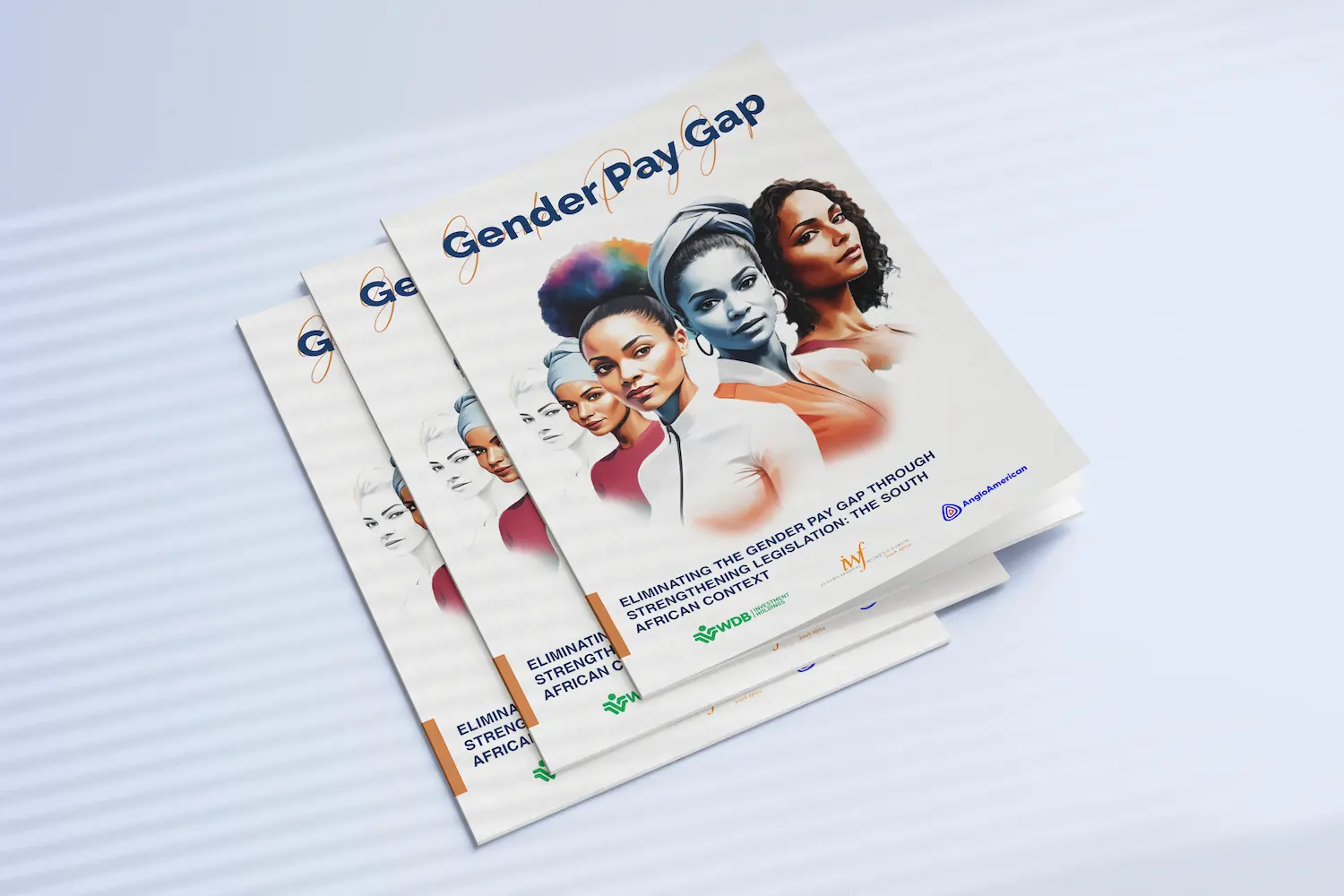
Gender Pay Gap Report
Comprehensive analysis of gender pay disparities across industries with policy recommendations.
(1.21 MB)